
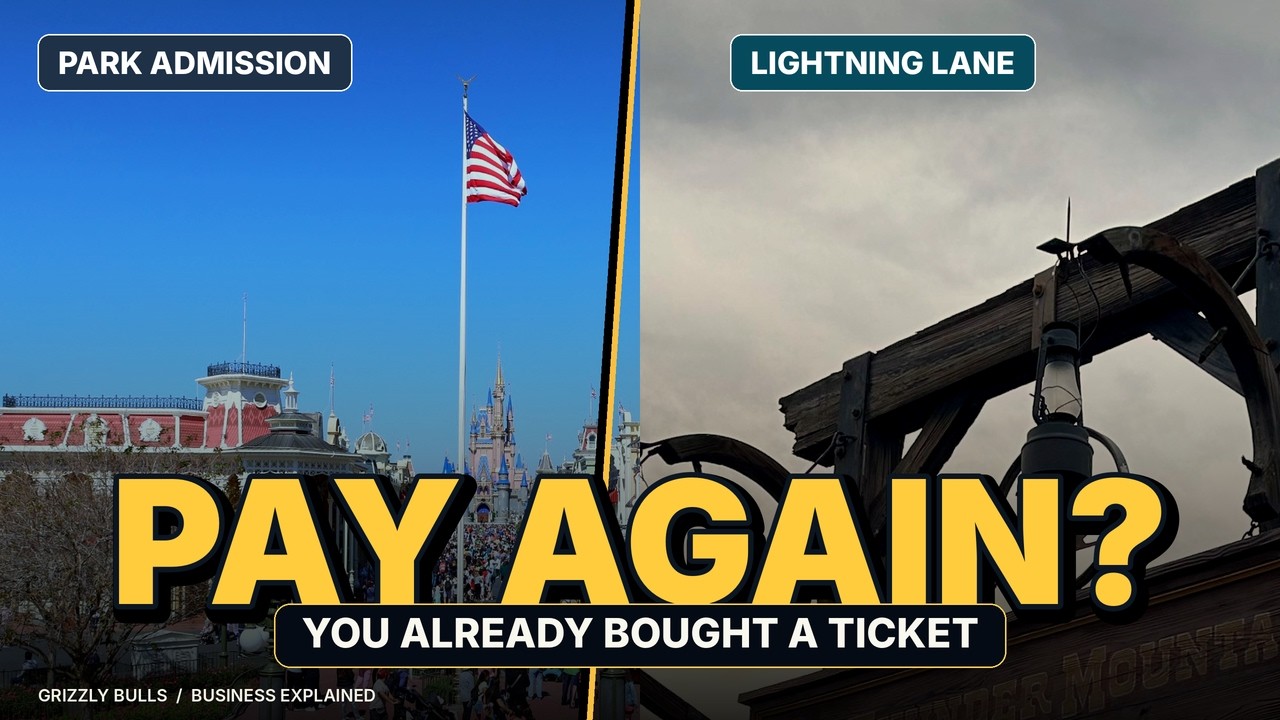
A ticket gets you into Disney World, but it doesn't guarantee that you'll spend most of your day on rides. You can be standing in a long standby line while another line, sometimes only a few feet away, keeps moving. The people in that shorter lane may have paid extra. That contrast is the story worth explaining: what exactly did they buy?
As of October 28, 2026, Walt Disney World sells several versions of Lightning Lane access. Regular standby access still exists. What Disney sells is an optional way to use selected attraction entrances, with different scheduling rules and limited availability. It does not change the fact that each ride has finite capacity. (research source)
You can still stand in the regular line
Disney's current guest guidance expressly preserves traditional standby queues. A visitor who doesn't purchase a Lightning Lane pass is not automatically barred from the attraction, although admission, ride eligibility, availability, closures and other park rules still apply. (research source)
That distinction matters. This is not a second admission ticket required of everyone. It is optional paid priority access alongside an ordinary route into the same underlying attraction. Whether the purchase is worth it will depend on the family, the day, the rides they care about and how much they dislike waiting. (research source, analysis snapshot)
Three products, not one unlimited fast pass
Disney's Multi Pass lets visitors plan up to three eligible experiences and arrival windows initially, then potentially add more after redeeming a selection, subject to availability. Single Pass is for eligible high-demand attractions that aren't included in Multi Pass; guests may purchase up to two per day, again subject to availability. (research source)
Premier Pass takes a different approach. It provides one-time entry to each available Lightning Lane experience in one designated park on one day, without choosing arrival windows. It is not an unlimited-ride guarantee. Prices vary by date and park for Multi and Premier, and by attraction and date for Single Pass; Disney directs guests to the My Disney Experience app for actual prices. (research source)
That means a single headline price often tells you very little. It may describe a different park, date, product or level of convenience from the one you're considering. (research source)
A ride cannot manufacture extra seats
The economic constraint is physical. Roller coasters, boat rides and other attractions can serve only so many guests in an hour. Priority access changes the route through the queue and allocation of access. It does not automatically make the ride dispatch more vehicles. (research source, analysis snapshot)
Here's a deliberately simplified illustration. Imagine a ride with capacity for 1,200 seats in an hour. Suppose one-quarter of that hour's capacity were allocated to priority guests. In this invented example, that's 300 seats for priority access and 900 for the ordinary queue. The total is still 1,200. These are illustrative inputs, not Disney attendance or capacity data. (analysis snapshot)
Even that arithmetic cannot tell us how long anyone actually waited. Arrival patterns, the number of people holding reservations, ride stoppages, dispatch timing and changes in visitor behavior all affect the line. A specific claim about standby delays would require real operating measurements that aren't in this illustration. (analysis snapshot, research source)
Someone's time is the product
A vacation day has an unusually hard deadline. A family might rationally pay more to spend fewer minutes in one queue and more time visiting other attractions, eating together or getting back to a hotel. Another family might rather keep the money and wait. Neither choice is inherently irrational. (research source, analysis snapshot)
The tension is what happens when some guests buy priority and others don't. Reserving capacity for one lane can change how the other lane flows. But we should be careful not to declare that all standby guests lose a specific number of minutes—or that Disney intentionally makes the regular line worse—without observing how the system operates. (research source, analysis snapshot)
It's useful to think of Lightning Lane as a market for convenience under capacity constraints, not as a magic way of building more rides instantly. That also explains why availability and scheduling are part of the product. (research source, analysis snapshot)
Disney's big financial numbers do not reveal Lightning Lane profit
For the fiscal quarter ended June 27, 2026, Disney reported $9.968 billion in Experiences revenue and $3.017 billion of segment operating income. It also reported $3.253 billion of theme-park admissions revenue. Those are genuine company figures and useful evidence of the scale of the overall business. (research source)
They are not the sales or margin of Lightning Lane. Experiences includes a broad portfolio of parks, cruise lines, resorts, food, merchandise, consumer products and other activities. The cited disclosure does not isolate Lightning Lane as its own revenue line. Any confident calculation of how much Disney makes from the shorter queue would need additional assumptions or evidence. (research source)
That's a useful limit on this investigation: we can explain the incentive to sell differentiated access, but we shouldn't produce a dramatic profit number by multiplying a fictional price by invented daily riders. (research source, research source, analysis snapshot)
A faster ride option is not a disability accommodation
Disney's Disability Access Service, or DAS, is a separate program for eligible guests who cannot wait in a conventional queue for an extended period because of a qualifying developmental disability or similar need under Disney's terms. Disney explains that DAS provides a return time comparable to the current standby wait, not immediate access. It should not be confused with buying Lightning Lane priority. (research source)
The real answer depends on the tradeoff
The shorter line exists because visitors value their limited vacation time differently, while the ride has a finite number of seats. A priority pass can be a useful purchase for some guests. Whether Disney's exact allocation is fair, efficient or good for the average visitor is a harder empirical question. We would need the park's queue allocations, wait distributions, capacity interruptions, real demand and guest outcomes before claiming a specific impact. (research source, analysis snapshot)
The practical conclusion is less cynical and more interesting than 'Disney just charges more.' It has found a way to sell time and convenience on top of admission. The part that remains open is how to balance the interests of people buying that time with everyone else sharing the same finite experience. (research source, analysis snapshot)
This analysis reflects official Disney policy and public reporting available through October 28, 2026; check Disney's current guest guidance before planning a trip. A companion Grizzly Bulls video will make the queueing mechanics visible with a deliberately hypothetical ride model, not real Disney dispatch telemetry. (research source, analysis snapshot)
Sources and methodology
This article is compiled from the reviewed Grizzly Bulls research package that supports the claims above.
The measured figures are a historical snapshot as of October 28, 2026; they should not be read as a claim that the underlying coverage is unchanged today.
- Hypothetical one-hour theme park priority versus standby seat allocation — Grizzly Bulls analysis, as of October 28, 2026.
- Walt Disney World Lightning Lane pass products and guest FAQ — Walt Disney World Resort, as of October 28, 2026.
- Walt Disney World Disability Access Service eligibility and return time — Walt Disney World Resort, as of October 28, 2026.
- The Walt Disney Company Form 10-Q for quarter ended June 27, 2026 — The Walt Disney Company / SEC, as of June 27, 2026.