
Billionaire net-worth pages can create an impression of precision: a name, a dollar figure, and a list of companies. Public-stock ownership looks like the easy part because the SEC publishes enormous amounts of ownership data. It is not.
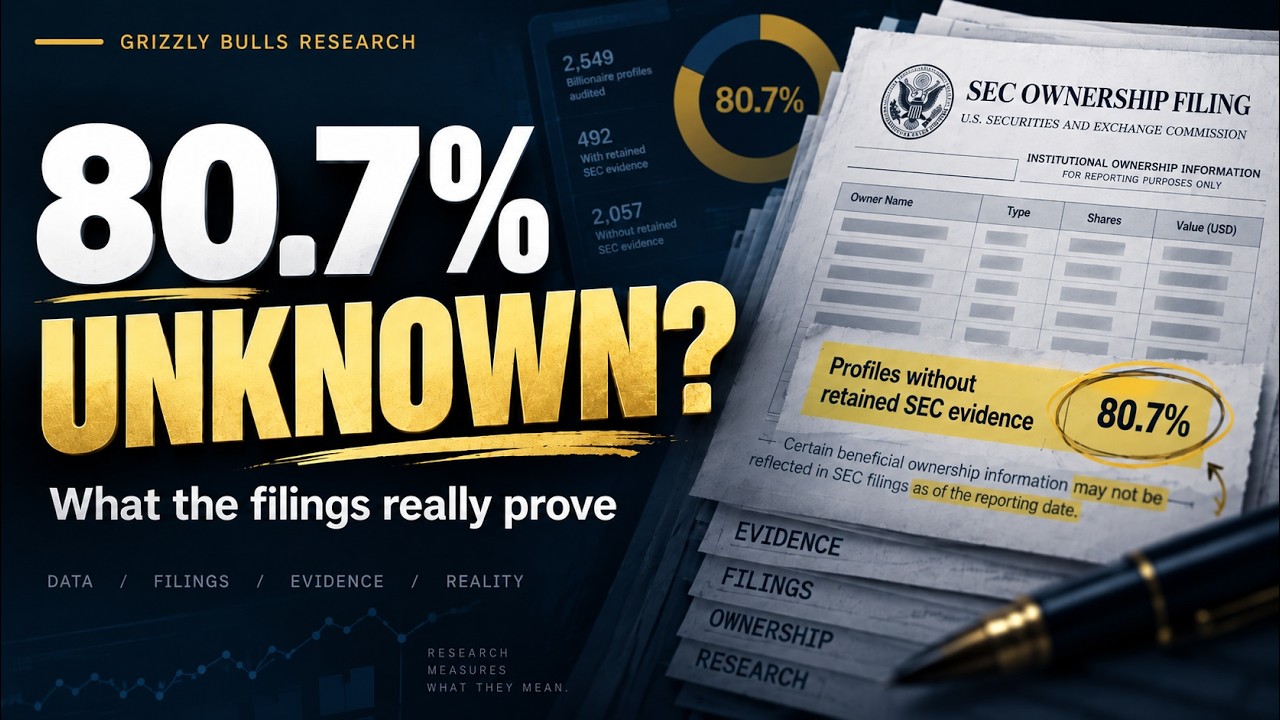
The retained September 6, 2026 Grizzly Bulls completeness census covered 2,549 billionaire profiles. (public census data)
Grizzly Bulls built a completeness census to measure a narrower question: how much current public-equity ownership can we actually support under the source, identity, security, freshness, and valuation rules we use? That is very different from asking how many billionaires own stock. A missing filing match is a research gap, not a negative holding.
For the citation-ready charts, methodology, limitations, and downloadable aggregate data, see the Billionaire Public-Equity Ownership Census.
What the audit found
The result was intentionally conservative. The goal was to count only positions that survive the evidence chain, not to maximize the number of tickers attached to famous names.
- At that snapshot, 492 of 2,549 profiles (19.3%) had any retained SEC position evidence in the supported Forms 3/4/5 or Schedule 13 pipelines. (public census data)
- The supported retained SEC pipelines had no position evidence for 2,057 profiles (80.7%) at that snapshot. (public census data)
- Only 19 profiles had a supported current public holding under the strict valuation/publication semantics used by the census snapshot. (public census data)
Read those as coverage metrics, not portfolio statistics. They tell us how far the supported evidence pipelines reached and how many profiles satisfied the current-holding contract. They do not tell us how many people in the universe actually own public securities.
The most important result is the empty state
Grizzly Bulls could not certify any profile as research-complete with no public holdings; missing retained evidence is therefore not evidence that a billionaire owns no public stock. (public census data, methodology and limitations)
That distinction is the most important editorial safeguard in this project. A database can fail to find a current supported holding because the source family never reached the person, because the reporting owner is unresolved, because the legal security is not mapped to a priced market unit, because the evidence is historical rather than current, or because freshness and valuation rules are not satisfied. None of those states is equivalent to a verified zero.
When evidence is incomplete, the honest output is an explicit gap. That is less visually satisfying than a clean empty portfolio, but it is much more useful research.
Why a filing match is not enough
Turning an ownership filing into a current holding requires several separate decisions:
- Is the reporting owner really the billionaire or a reviewed related holder?
- Does the issuer match the company we think it does?
- Which legal security or share class is actually reported?
- Is the position direct, indirect, aggregate beneficial ownership, or another economic form?
- Does the record describe a current position or only a historical transaction?
- Does any conversion, exchange right, or market-unit mapping preserve the correct economic units?
- Is there a valid priced market instrument for the position?
- Is the observation fresh enough for the claim being made?
- Has the evidence passed the review boundary required for public use?
A naive name-to-ticker scrape collapses those questions into one assumption. That can produce a much fuller-looking portfolio, but it also makes it easy to double-count ownership, price the wrong security, mistake an old transaction for a current position, or attach a filing to the wrong person.
Source reach was the real bottleneck
The dominant first blocker was retained-sec-source-gap, affecting 1,975 profiles (77.5% of the universe), so source reach was a much larger bottleneck than the narrower holder, security, or current-position semantic queues. (public census data)
This matters because it changes where more engineering and research effort should go. If the dominant problem were a small cleanup queue, the next move would be to resolve edge cases one by one. The census instead says the bigger opportunity is broader source-family coverage, followed by the semantic review needed to promote evidence safely.
That is also why simply scraping more rows from the same sources is not enough. Better billionaire research needs more kinds of evidence and clearer rules for what each source can prove.
The same authority problem appears in basic profile facts
Trusted-complete profile-fact coverage was zero because residence, education, and current title had no source-backed coverage under the then-current authority contract. (Billionaire Public-Equity Ownership Census)
The legacy corpus can still contain a value without that value meeting the newer source-backed authority standard. The same distinction applies to holdings: availability is not authority. A field that exists is not automatically a fact we should publish as current.
What this changes about billionaire research
The interesting story is not that billionaires rarely own public stocks; it is that proving current billionaire ownership at scale requires more source families and explicit identity, security, holder, freshness, and valuation semantics than a naive filing scrape suggests. (Billionaire Public-Equity Ownership Census)
For readers, the practical takeaway is simple: precision should come after provenance. A useful billionaire profile should show what is supported, when it was observed, and what remains unresolved. That approach can make some pages look less complete in the short run, but it creates a research product that can improve without silently rewriting uncertainty as certainty.
Grizzly Bulls will continue expanding the evidence graph and rerunning the same completeness methodology as new sources and reviewed mappings come online. You can browse the Grizzly Bulls Billionaires Index while that work progresses.
Sources and methodology
This article is compiled from the reviewed Grizzly Bulls research package that supports the claims above.
The measured figures are a historical snapshot as of September 6, 2026; they should not be read as a claim that the underlying coverage is unchanged today.
- Billionaire Public-Equity Ownership Census — public methodology, charts, limitations, and suggested citation.
- Aggregate census data (JSON) — Grizzly Bulls derived measurement, data snapshot September 6, 2026.
- Aggregate census data (CSV) — reusable aggregate figures from the same retained measurement.